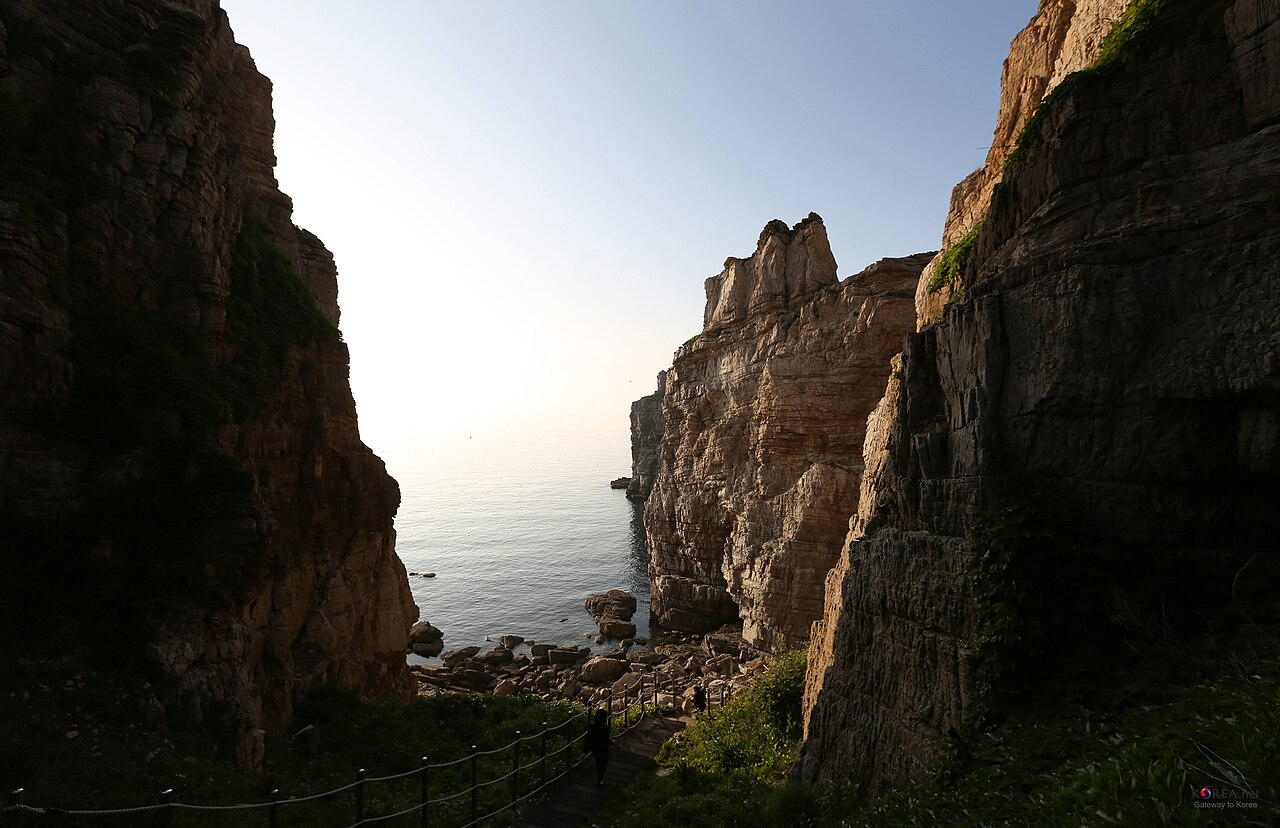
Baengnyeong Island: Korea's Remote Northern Frontier
Korea's northernmost inhabited island, located just 12 km from North Korean shores, Baengnyeong Island offers dramatic basalt cliffs, seal colonies, black sand beaches, and an eerie frontier atmosphere found nowhere else in the country.
Photo: Wikipedia Commons
What Is Baengnyeong Island?
Baengnyeong Island (백령도) is the northernmost inhabited island of South Korea, located in the northern Yellow Sea approximately 200 km northwest of Seoul and only 12 km from the North Korean coastline. The island covers 51.2 km² and has a population of about 5,000 residents, mostly fishermen and military personnel. It belongs to Ongjin County, Incheon, and entry requires prior registration with the Korea Coast Guard due to its sensitive military location. The island is known for its geological drama — basalt lava formations, sea caves, natural stone bridges, and the unique Kongdol Beach (콩돌해안), whose entire surface is covered in smooth, round pebbles rather than sand.
History & Significance
Baengnyeong Island's position near the Northern Limit Line (NLL) — the disputed maritime boundary between North and South Korea — has given it an outsized historical and geopolitical significance. The island has been the site of several serious military incidents, including the sinking of the ROKS Cheonan naval vessel in 2010, which killed 46 South Korean sailors. Despite these tensions, the island maintains a civilian population and has been promoted as a destination for domestic tourism since the early 2000s. The waters around the island are renowned for king crab and sea cucumber, supporting a significant fishing industry, and the island is one of the best places in South Korea to observe the endangered spot-nosed seal (점박이물범).
What to See & Do
The geological highlights include Dumujin (두무진), a series of towering basalt sea stacks rising from the water on the island's northwestern coast — often called the 'Geumgang Mountain of the Sea.' Boat tours depart from the harbour and circle these formations at close range. Kongdol Beach is covered entirely in smooth grey pebbles the size of eggs, producing a distinctive rattling sound with each wave. The nearby Sagot Beach features unusually flat, natural landing strips used by the military. Spot-nosed seals can often be observed on sandbars near the island between October and April. Military-related sites (including a memorial for the Cheonan) provide sober historical context.
Visitor Tips
Getting to Baengnyeong Island requires a 4-hour ferry journey from Incheon's Yeonan Pier — an overnight trip is highly recommended to maximise time on the island. The ferry schedule is weather-dependent and sailings are cancelled regularly in winter storms; build flexibility into your itinerary. Visitors must register with the Incheon Coast Guard in advance (a straightforward online process). Accommodation options are limited; book early, especially for summer and autumn visits. The island has very little tourist infrastructure, which is exactly its appeal — the combination of dramatic scenery, near-zero tourism, and the palpable proximity to the border creates an atmosphere genuinely unlike anywhere else in South Korea.
Tips
- 💡The 4-hour ferry from Incheon is worth it — almost no tourists, extraordinary scenery, and a border atmosphere unlike anywhere else in Korea.
- 💡Book the overnight ferry to maximise time; the sailing schedule depends entirely on Yellow Sea weather.
- 💡October–April: look for spot-nosed seals on sandbanks — one of the rarest wildlife encounters in Korea.
Last updated: April 1, 2026
You might also like
N Seoul Tower: Seoul's Most Iconic Landmark
Perched atop Namsan mountain, N Seoul Tower offers breathtaking 360-degree views of the city and has become a beloved symbol of Seoul's modern romance.
Hongdae: Seoul's Creative Youth Capital
Seoul's most vibrant arts and nightlife district, Hongdae pulses with indie music, street performances, quirky cafés, and the creative energy of Korea's top arts university.
Gyeongbokgung: Seoul's Grand Joseon Palace
The largest and most magnificent of Seoul's Five Grand Palaces, Gyeongbokgung served as the heart of the Joseon Dynasty for over 500 years.