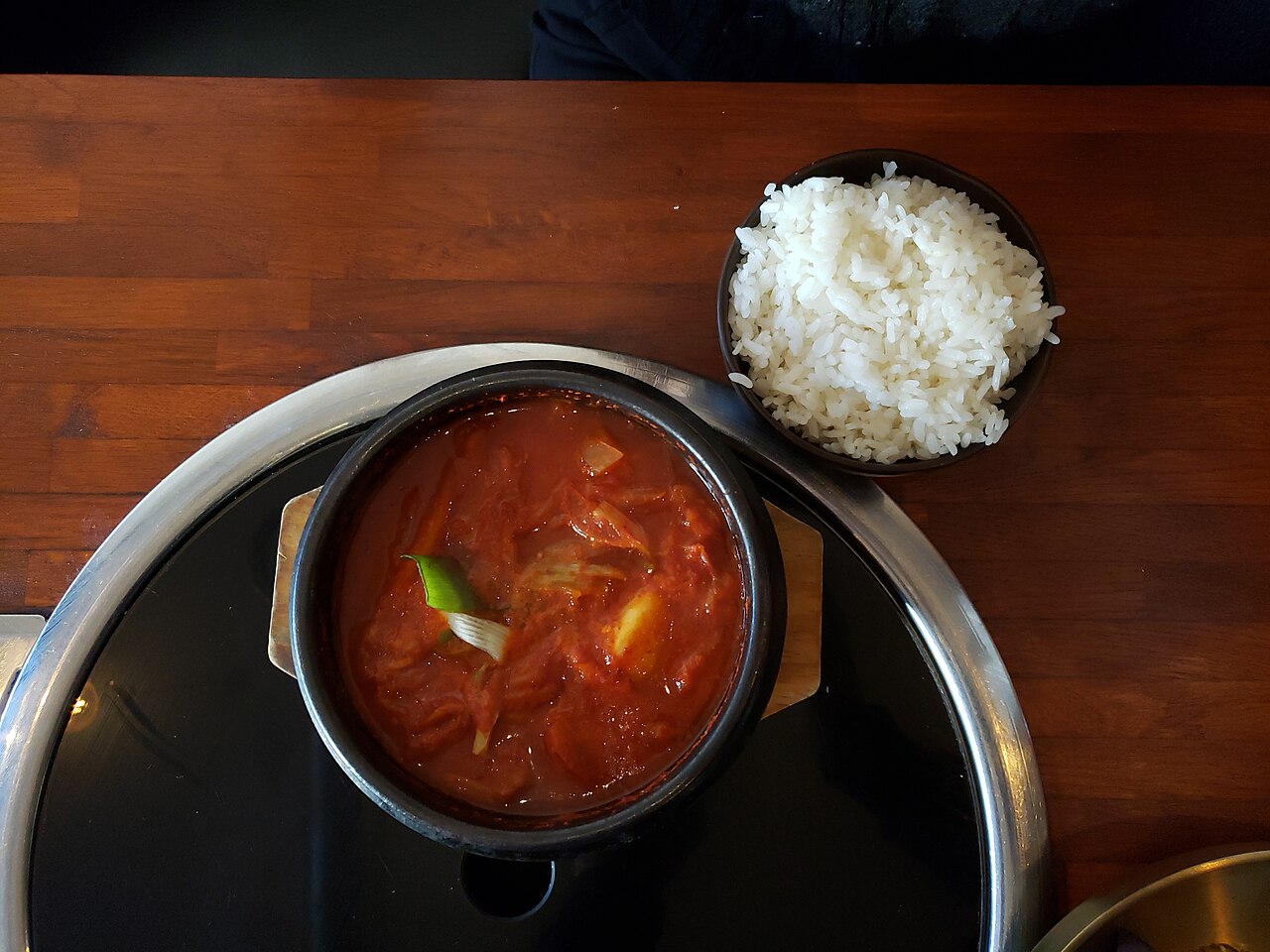
Kimchi Jjigae: Korea's Most Comforting Stew
Bubbling hot, deep red, and unmistakably Korean — kimchi jjigae is the stew that every Korean home smells like on a cold evening.
Photo: Wikipedia Commons
⚡ Quick Facts
Korean name
김치찌개 (Kimchi Jjigae)
Type
Stew (찌개, jjigae)
Key ingredient
Aged fermented kimchi (묵은지)
Common proteins
Pork belly, canned tuna, beef
Served with
Steamed rice + banchan (always)
Best kimchi age
3+ months fermented
Heat level
Medium-high (varies by cook)
Meal context
Breakfast, lunch, dinner, hangover cure

What Is Kimchi Jjigae?
Kimchi jjigae (김치찌개) is Korea's most beloved stew — a deeply savory, spicy, scarlet broth built from fermented kimchi, pork (or tuna), tofu, and often mushrooms. The name breaks into two words: kimchi (김치) and jjigae (찌개), meaning 'stew' or 'pot.' Unlike lighter soups (guk), jjigae is meant to be thick, concentrated, and intensely flavored — always served bubbling in a stone pot or ceramic bowl, and eaten communally from the center of the table. If samgyeopsal is the weekend celebration and bibimbap is the artful one-bowl meal, kimchi jjigae is the weeknight ritual. Koreans eat it for breakfast, lunch, and dinner. It appears on every restaurant menu, in every army base, in every grandmother's kitchen. It is, by most accounts, the most frequently eaten stew in Korea.
The Secret: Old Kimchi
The single most important rule of kimchi jjigae: the kimchi must be old. Freshly made kimchi is bright and crunchy, which is pleasant on its own — but it lacks the fermented depth and sourness that transforms into something extraordinary when cooked. Koreans specify this precisely: the ideal kimchi for jjigae is 묵은지 (mugeun-ji), meaning 'aged kimchi' — kimchi that has been fermenting for at least three months, preferably through a full winter. As kimchi ages, its acidity deepens, its flavor becomes more complex, and the cabbage develops a softness that survives long cooking. The sour, funky, intensely pickled quality of mugeun-ji is not a flaw — it is the point. It is what gives kimchi jjigae its irreplaceable backbone.
- ·신김치 (sin-kimchi) — fresh kimchi, 1–4 weeks old: too bright and crunchy for jjigae
- ·익은김치 (igeun-kimchi) — ripe kimchi, 1–3 months: acceptable, flavor developing
- ·묵은지 (mugeun-ji) — aged kimchi, 3+ months: ideal, deeply sour and complex
- ·묵은지 (winter-fermented) — the holy grail: slow cold fermentation creates exceptional depth

The Anatomy of a Perfect Pot
At its core, kimchi jjigae is simple — aged kimchi, protein, tofu, broth, and time. But every cook has their version, and minor variations produce dramatically different results. **The kimchi**: Aged napa cabbage kimchi, cut into rough pieces. The cabbage wilts and softens, releasing its fermented liquid into the broth. **The protein**: Most commonly pork belly (삼겹살) or pork shoulder, sliced thin and cooked until tender. The fat from the pork absorbs the kimchi's flavor and releases it back into the broth. Canned tuna is the second most common version — jjigae made with tuna (참치 김치찌개) has its own devoted following and is standard in Korean army-style cooking (부대찌개 adjacent). **The tofu**: Silken or medium-firm tofu, added near the end and kept in large chunks. It absorbs the broth and provides a cooling, mild contrast to the spice. **The broth**: Often a light anchovy-and-kelp stock (멸치육수), which adds subtle umami without overpowering the kimchi. Water alone works, too — the kimchi itself provides extraordinary flavor. **The finishing touches**: A spoonful of gochugaru (red chili flakes) for heat, a splash of fish sauce for depth, sesame oil swirled in just before serving.
How Koreans Eat It
Kimchi jjigae is always served with rice — always. The rice is not mixed in; it sits in its own bowl and is eaten alongside, each spoonful of stew scooped over the rice or eaten in alternation. The stew pot is placed at the center of the table, still bubbling on a portable burner, and shared by everyone. The rhythm of the meal is this: a bite of rice, a spoonful of jjigae with a piece of tofu or pork, a bit of banchan (side dish), repeat. The heat of the pot keeps the broth at boiling throughout the meal — you're eating it as it cooks. The flavor at the bottom of the pot intensifies as the meal progresses. Koreans also eat kimchi jjigae the morning after drinking. The sourness and salt cut through the fog of soju. A 24-hour jjigae restaurant near a Korean university campus is always full after 2am.
Regional Variations and Family Recipes
Unlike bibimbap, which has one definitive Jeonju version, kimchi jjigae is fundamentally a home dish — meaning every family has the definitive version, and all of them are right. Some families add a splash of doenjang (fermented soybean paste) for earthier depth. Others use gochujang instead of or alongside gochugaru. Coastal regions use fresh seafood — clams, shrimp, or oysters — instead of pork. Army base stew (부대찌개, budae jjigae), born from post-Korean War American military base surplus, incorporates hot dogs and SPAM alongside kimchi — now a beloved dish with its own restaurants. The one constant across every version: the kimchi must have been fermented long enough to be sour. Without that, it is soup. With it, it is 김치찌개.
- ·돼지고기 김치찌개 — with pork belly: the classic version
- ·참치 김치찌개 — with canned tuna: quick, pantry-based, equally beloved
- ·두부 김치찌개 — tofu-forward, less meat: lighter protein version
- ·부대찌개 — army base stew with SPAM, hot dogs, ramen noodles: a postwar tradition
- ·해물 김치찌개 — seafood version: clams, shrimp, common in coastal areas
The Smell of Home
Ask any Korean living abroad what they miss most about home, and the answer is almost always food — and within food, kimchi jjigae surfaces constantly. The smell of aged kimchi hitting hot oil in a pan, then the steam as broth is added, is one of the most evocative scent memories in Korean culture. It is the smell of a mother cooking after school. Of a grandparent's kitchen in winter. Of the corner restaurant where you ate alone during exam season. Kimchi jjigae is not just a dish — it carries the weight of ordinary Korean life. That is why, of all Korea's extraordinary cuisine, this rough, simple, communal stew might be the most irreplaceable.
Last updated: April 1, 2026
You might also like
Miyeok-guk: The Birthday Soup That Is Really About Your Mother
Miyeok-guk is the seaweed soup every Korean eats on their birthday — a tradition that began as postpartum recovery food and became an annual act of gratitude to one's mother.
Chimaek: Why Korean Fried Chicken Is the World's Best
Korea has more fried chicken restaurants than McDonald's has locations worldwide. Here's the science and culture behind the crunch.
Samgyeopsal: Korea's Ultimate BBQ Experience
Discover why samgyeopsal — grilled pork belly — is the heart of Korean dining culture and a must-try experience.