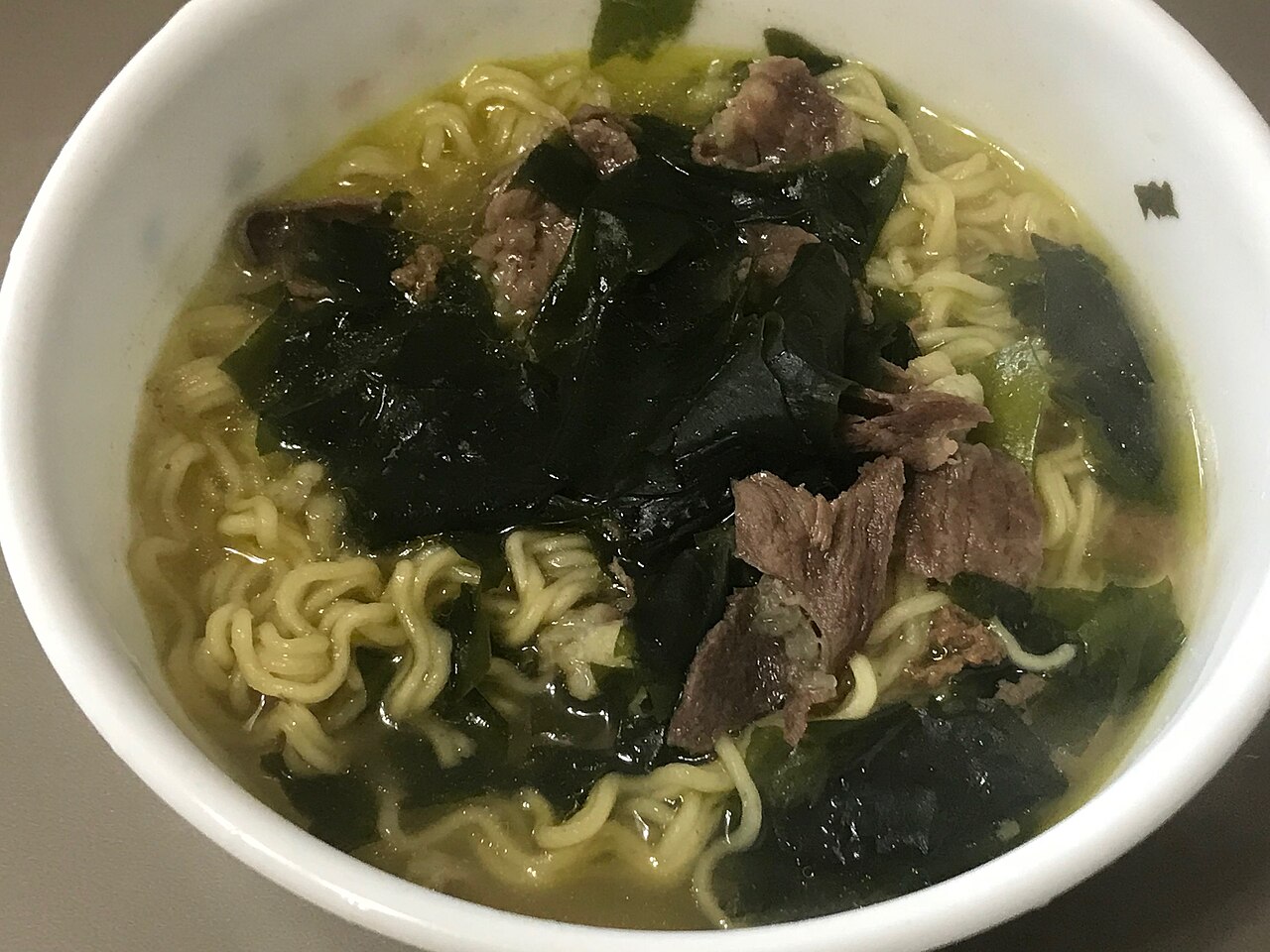
Miyeok-guk: The Birthday Soup That Is Really About Your Mother
Miyeok-guk is the seaweed soup every Korean eats on their birthday — a tradition that began as postpartum recovery food and became an annual act of gratitude to one's mother.
Photo: Wikipedia Commons
What Is Miyeok-guk?
Miyeok-guk (미역국) is a Korean soup made from miyeok — a type of sea vegetable known in English as brown seaweed or wakame. Dried miyeok is rehydrated until it swells and softens, then sautéed in fragrant sesame oil with beef (most commonly) or shellfish, and simmered in water or stock until the seaweed becomes silky and tender. The soup has a clean, savory quality with a characteristic slight slipperiness from the seaweed — a texture that, as we will see, becomes culturally significant in ways that go far beyond the bowl. Miyeok-guk is eaten at many times throughout the year — as an everyday health tonic, as a recovery food after illness, and as a general comfort dish. But its most meaningful appearance is on birthdays, where it is not merely traditional but carries the weight of a cultural ritual. For Koreans, eating miyeok-guk on your birthday is not simply a custom. It is an act of memory and gratitude that connects you to your mother on the day that belongs equally to her.
Why Koreans Eat It on Their Birthday
The birthday tradition is rooted in one of the most fundamental practices of Korean maternal care: postpartum recovery. In Korean tradition, a new mother eats miyeok-guk three times a day for a minimum of three weeks after giving birth — and in traditional practice, for as long as 100 days. This was not arbitrary. Miyeok is exceptionally rich in the nutrients that postpartum bodies need: calcium for bones weakened by pregnancy, iron to replenish blood lost during delivery, iodine for thyroid function and infant brain development through breast milk, and folate for cellular recovery. For centuries, Korean culinary wisdom intuited this match between miyeok's nutritional profile and postpartum needs before nutritional science could explain why. The result was a practice so consistent and universal that miyeok-guk became inseparable from the experience of giving birth and being cared for after it. When a child grows up and celebrates their birthday, eating the same soup completes a profound circle. In Korean culture, your birthday is not only the day you were born — it is also the day your mother labored to bring you into the world. Eating miyeok-guk on that day is a quiet, edible acknowledgment of what she went through. Many Koreans call their mother first thing on their birthday — not to receive congratulations, but to thank her. The bowl of miyeok-guk on the table is the same sentiment in physical form.
The Exam Taboo: Never Before a Test
Miyeok-guk holds a powerful dual identity in Korean culture. The same soup that is eaten on birthdays to honor mothers is also one of Korea's most strictly observed food taboos — specifically, it must never be eaten before an important exam. The logic is linguistic and symbolic. Miyeok's defining characteristic is its slipperiness, and the Korean verb 미끄러지다 means 'to slip,' 'to slide,' or — in the context of exams and applications — 'to fail.' Eating a slippery food before an exam is feared to cause your knowledge to 'slide' out of your head, or to cause you to 'slip' through the examination. This taboo is most intensely observed around the Suneung (수능) — Korea's national college entrance examination, one of the most high-stakes days in any young Korean's life. The entire country treats the Suneung with extraordinary seriousness: planes are grounded during the listening section, construction halts near exam centers, and police escort late students. In this context, it would be genuinely alarming for a Suneung student to find miyeok-guk on the breakfast table — an act roughly equivalent, in its cultural weight, to wishing someone bad luck on their wedding day.
- ·Birthday breakfast: universally eaten to honor the mother's sacrifice
- ·Postpartum recovery: eaten three times daily for weeks after giving birth
- ·General health tonic: consumed throughout the year for wellbeing
- ·Before exams: strictly avoided due to the 'slipping/failing' association
The Nutritional Power of Miyeok
Beyond its cultural meanings, miyeok is a genuinely remarkable ingredient from a nutritional standpoint. It contains more calcium by weight than cow's milk, making it one of the richest plant-based sources of calcium available. It is one of nature's most concentrated sources of iodine, a mineral critical for thyroid function and — critically for postpartum contexts — for infant brain development through breast milk. It is also rich in iron, folate, and vitamin K. Miyeok also contains alginic acid, a type of soluble fiber that has been shown to help reduce blood cholesterol levels and support digestive health. It is low in calories and high in micronutrients, fitting the profile of what contemporary nutritionists would call a 'superfood' — though Korean culinary tradition had recognized and codified its value centuries before that term existed. This nutritional density helps explain why the postpartum practice of eating miyeok-guk persisted so consistently across Korean history. It was not merely tradition for tradition's sake — it worked. The mothers who ate it recovered better, and their intuitive wisdom accumulated into cultural knowledge that passed from generation to generation.
What Birthdays Mean in Korea
Miyeok-guk illuminates something deeper about how birthdays are understood in Korean culture. In many Western cultures, a birthday is primarily a celebration of the person being born — their existence, their journey through another year. The focus is inward: your day, your cake, your gifts, your friends gathered for you. In Korean culture, this orientation is there, but it is accompanied by another: the understanding that a birthday is also the anniversary of your mother's labor and sacrifice. The day you were born was the day she went through something extraordinary for you. Eating miyeok-guk is a way of not letting that be forgotten — of acknowledging, in the most ordinary and domestic of ways, that your existence cost someone something real. This perspective does not diminish the joy of celebration. Korean birthdays can be exuberant, full of food and friends and music. But the bowl of miyeok-guk in the morning, and the call to your mother, add a dimension of gratitude and intergenerational connection that gives Korean birthdays a particular depth. It is a culture in which the personal and the relational are never quite separated — and miyeok-guk is the bowl that holds them together.
Tips
- 💡If a Korean person mentions eating miyeok-guk today, it is almost certainly their birthday — a gentle and culturally appreciated way to acknowledge it.
- 💡Never serve miyeok-guk to a Korean student before an important exam — the superstition is genuinely observed and taken seriously.
- 💡Miyeok-guk is easy to make at home with dried miyeok available at Korean grocery stores — a batch with beef and sesame oil is a deeply comforting and nutritious meal.
Last updated: April 1, 2026
You might also like
Kimchi Jjigae: Korea's Most Comforting Stew
Bubbling hot, deep red, and unmistakably Korean — kimchi jjigae is the stew that every Korean home smells like on a cold evening.
Chimaek: Why Korean Fried Chicken Is the World's Best
Korea has more fried chicken restaurants than McDonald's has locations worldwide. Here's the science and culture behind the crunch.
Samgyeopsal: Korea's Ultimate BBQ Experience
Discover why samgyeopsal — grilled pork belly — is the heart of Korean dining culture and a must-try experience.