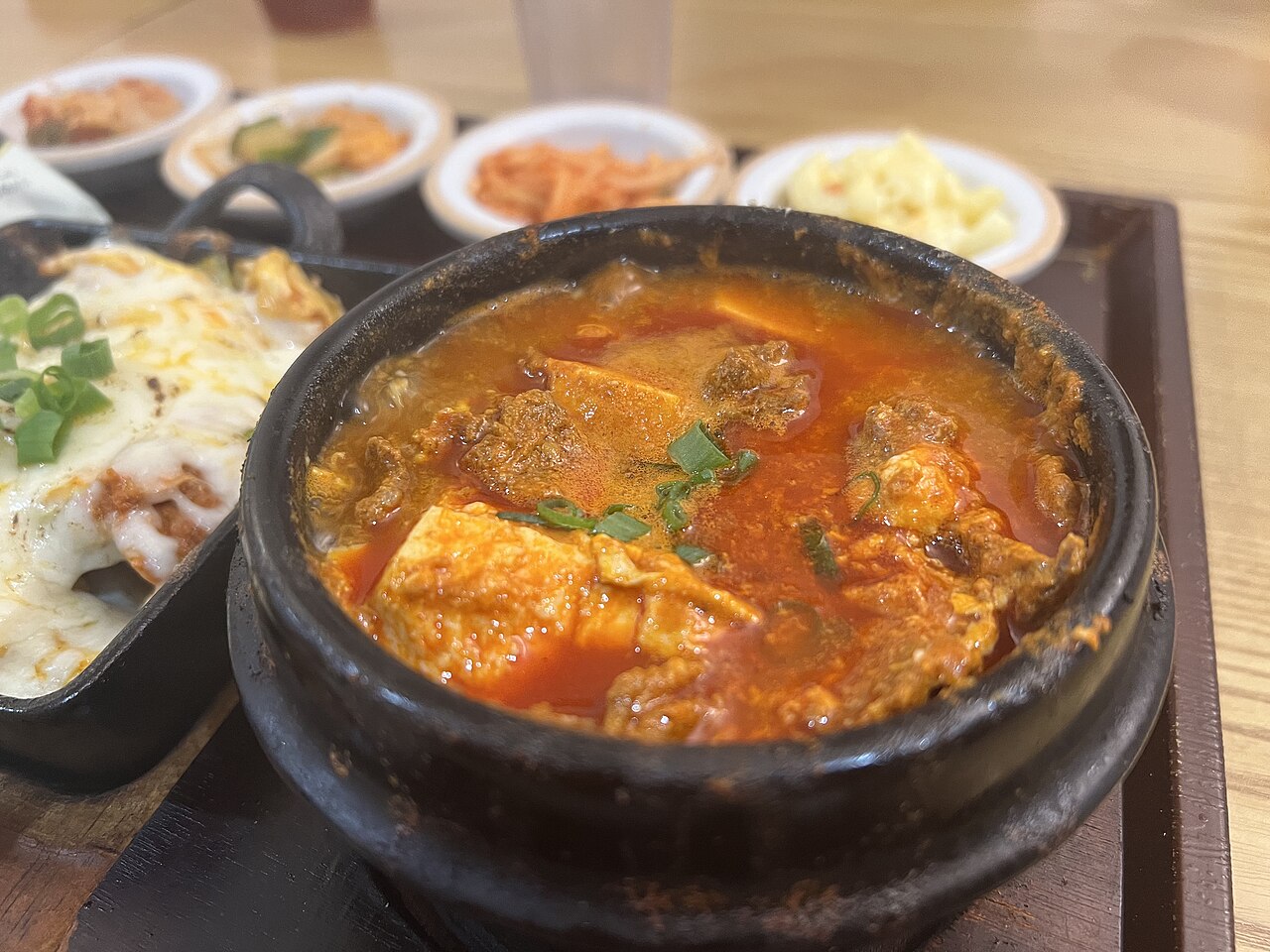
Chodang Sundubu: Tofu Made with the Sea
Gangneung's legendary sea-water tofu — impossibly silky, mineral-fresh, and a masterpiece of Korean regional cuisine.
Photo: Wikipedia Commons
What Is Chodang Sundubu?
Chodang sundubu (초당순두부) is a style of extraordinarily soft tofu (순두부, sundubu) that originates from the Chodang neighborhood in Gangneung, on Korea's east coast. What distinguishes it from all other Korean tofu is the coagulant used in production: instead of the standard nigari (magnesium chloride, called gansu in Korean) used to set conventional tofu, Chodang sundubu is coagulated with fresh East Sea seawater. The seawater coagulation method produces tofu of almost unbelievable delicacy. The curds form more slowly and gently than with chemical coagulants, resulting in a silken texture that trembles on contact and melts on the tongue before any chewing is necessary. The flavor carries the marine minerals of the East Sea — a faint, clean salinity that tastes like distilled ocean air rather than salt. Sundubu in the Chodang style is typically served fresh and plain — just the set curds, often still warm from the pot, with a small dish of seasoned soy sauce (yangnyeom ganjang) made with green onion, sesame, and a pinch of chili. There is no elaborate processing, no additional seasoning in the tofu itself — the flavor is entirely the expression of the soybean and the sea.
History & Origins
The origin legend of Chodang sundubu traces to the mid-Joseon dynasty and a man named Heo Yeop, the father of the famous writer Heo Gyun (허균, 1569–1618), who authored Hong Gildong Jeon — Korea's first vernacular novel. Heo Yeop served as a magistrate in Gangneung, and according to local tradition, he devised the method of using East Sea seawater to coagulate tofu when he realized the mineral-rich local water produced a superior result to conventional methods. Whether or not the legend is historically precise, the Chodang neighborhood of Gangneung has been associated with exceptional tofu production for centuries. The combination of high-quality local soybeans, clean mountain water for soybean soaking and washing, and mineral-dense East Sea water for coagulation creates a specific terroir for tofu — a concept rarely applied to this humble food but entirely appropriate in this case. Chodang sundubu gained national and international recognition in the late 20th century as food tourism developed around Korean regional specialties. Today, a dedicated cluster of sundubu restaurants lines the streets of Chodang-dong in Gangneung, attracting visitors who make the journey specifically for the tofu. The neighborhood is listed on Korean culinary heritage databases as a living food culture zone.
How Koreans Eat It
Chodang sundubu is a food that rewards restraint — the less you add to it, the more clearly you can taste what makes it special.
- ·Raw sundubu with seasoning: The most revelatory preparation. Fresh curds are placed in a bowl still warm, and a small amount of seasoned soy sauce is drizzled over the top. Nothing else. Eat slowly and notice the texture.
- ·Sundubu-jjigae (순두부찌개): The Chodang style sundubu is also used in the classic spicy tofu stew. The silky curds break apart in the spicy broth, creating tender islands of tofu in a red, intensely flavored soup base.
- ·Tofu course meal: Many Chodang restaurants serve a full course of tofu preparations — raw fresh tofu, pan-fried tofu, tofu stew, and braised tofu — across multiple small dishes, allowing guests to experience the ingredient in its various transformations.
- ·Dubu buchim (두부부침): Pan-fried tofu sliced thickly and pressed on a hot oiled pan until golden. The contrast between the crispy exterior and the soft interior of Chodang-quality tofu is particularly striking.
Cultural Significance
Chodang sundubu represents something important in Korean food culture: the idea that the most profound culinary experiences often come from the simplest ingredients prepared with deep attention to their natural qualities. In a food landscape defined by bold flavors, complex fermentations, and dramatic cooking techniques, a bowl of plain fresh tofu made with seawater occupies an unusual position — quiet, unassuming, and deeply satisfying in a way that more elaborate dishes cannot replicate. For Korean food writers and chefs, Chodang is often cited as evidence that Korean cuisine is not only about spice and fermentation — there is a parallel tradition of subtlety, restraint, and ingredient purity that is equally sophisticated. Eating at a traditional Chodang sundubu restaurant is an exercise in unlearning the assumption that more seasoning always means better flavor. The Chodang area also holds practical appeal for visitors: Gangneung, accessible by KTX high-speed rail in under two hours from Seoul, offers the sundubu experience alongside the city's other major attraction — the stunning Gyeongpo Lagoon and the East Sea coastline. The combination of sea scenery and sea-tasting tofu creates a coherent sensory experience that many visitors describe as one of their most memorable Korea moments.
Tips
- 💡Take the KTX from Seoul to Gangneung (approximately 1h 45min) and then a taxi to the Chodang Tofu Village — it is a manageable day trip from Seoul.
- 💡Order the raw fresh sundubu (생순두부) first before any cooked preparations — this is where the seawater terroir is most clearly tasted.
- 💡Chodang sundubu is an excellent option for vegetarian and vegan travelers — plain tofu served with soy dipping sauce contains no animal products.
Last updated: April 1, 2026
You might also like
Kimchi Jjigae: Korea's Most Comforting Stew
Bubbling hot, deep red, and unmistakably Korean — kimchi jjigae is the stew that every Korean home smells like on a cold evening.
Miyeok-guk: The Birthday Soup That Is Really About Your Mother
Miyeok-guk is the seaweed soup every Korean eats on their birthday — a tradition that began as postpartum recovery food and became an annual act of gratitude to one's mother.
Chimaek: Why Korean Fried Chicken Is the World's Best
Korea has more fried chicken restaurants than McDonald's has locations worldwide. Here's the science and culture behind the crunch.